
THE TRUE ST. GEORGE
Courtesy of ‘The National Message’ April 1956
Few countries know less of their national Saint than the English. Perhaps that is because this year is the one thousand , six hundred and fifty-second anniversary of his martyrdom. To mark the occasion we present the story of George’s life and death, based upon Isabel Hill Elder ‘s George of Lydda
There was an unmistakably festive air in the household of His Imperial Majesty’s Governor of Lydda, in Palestine. The time: AD 280. The occasion: the birth of a son to the Governor’s wife.
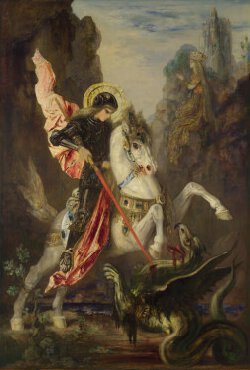 It was a great day for England, too. For the young lad was marked out to become the Patron Saint of the English, the flower of Christian chivalry and manhood, the dragon slaying hero of a hundred generations of wide eyed British youngsters.
For has not such a story from of old
Down man’s successive generations roll’d?
The Governor’s residence lay twenty three miles northwards from Jerusalem in the beautiful plain of Sharon, a peaceful enough background for the soldier- saint’s childhood one would have imagined: amidst verdant pastures and encircling olive groves, creeping vines and the rich foliage of the apricot and mulberry, it betrayed no hint of the fate and untimely death laid up for the young boy.
George’s family was well known and respected in those parts; of long Christian ancestry, dating back to the days when St Peter came to Lydda and brought about the conversion of all that dwelt at Lydda and Sharon (Acts 9: 32-35 ).
They were fine days. Since then the family had been a tower of strength to the Faith, and was destined to become a greater; for the young child of military count of the Roman Empire was to be in the forefront of the band that was to deal the blow to send paganism reeling into the abyss.
But tragedy struck the Governor’s household. Before George had reached his eleventh year: his father died quite suddenly, at the early age of thirty six.
This meant a big change for the people of Lydda. For one thing, a new Governor was appointed from the capital of the Empire.
According to the records, he arrived to take his new post with great pomp befitting such a dignity.
Apparently young George captured his heart immediately as one document has it, of much beauty of person and an exquisite courtesy’.
Governor Justus seems to have felt some personal responsibility for the education and future of his predecessor’s son. Anyhow, he provided George with a first-class military training and, in due time, sent him off as a newly fledged centurion to the court of the Emperor Diocletian, whose name was to go down in history as the Arch-Butcher of Christians. Although, in point of fact, it was the sharp reaction of powerful devotees of the old religion against progressive Christianity which forced his hand.
George’s career began well enough, for upon learning of his rank and good birth, the Emperor soon advanced the young Galilean in his service by a series of rapid promotions, first to General and finally to Military Tribune of the Imperial Guard.
By the way, ‘George’ is almost certainly his baptismal name, adopted by the Church when he was canonized. He was probably known as ‘Nestor’ in his lifetime; in fact some think he founded the Nestorans, a group of Christians in Persia: well, it is not unlikely, for he was certainly there in the campaigns of Galerius. And the Nestorians, says tradition, ‘were originally sons of Israel and not Gentiles’.
It was during these campaigns that George met Constantine, surnamed the Great, British born future Emperor of Rome, who, later, was responsible for proclaiming George Champion of Christendom.
In all the Empire two more significant persons were hardly to be found. Both were to exercise a profound influence upon Roman history. As companions–in arms they became firm friends, and George is said to have received a great welcome at York Constantine’s home – after sailing up the channel, later to bear his name (St George’s) to land on that part of the coast known to later generations as the County of Lancaster. To this day, York bears the shield of St George-a red cross upon a silver ground-a lingering testimony of the visit. There are some intriguing stories too, of a visit to Glastonbury.
But all too soon, the clouds began to gather around his career in the imperial service, for the pagan gods were in their death throes before the sustained assault of the Christian Faith. Galerius, Diocletian’s second in command, had finally prevailed upon the Emperor to suppress it. Paganism was preparing its devastating come back. The time had come for the world to make its choice: the old order, or the new.
Christians began to be deprived of their offices and civil rights churches were destroyed and Sacred Scriptures burned. In the Eastern Empire 38, 000 Christians were slaughtered.
Just how George became involved it is difficult to say. The most likely story is that, enraged by the callous destruction of the churches and Scriptures, he tore down notices ordering such action.
The authorities acted swiftly and terribly. The intrepid young noble found himself, stripped of. his armour and rank, arraigned before a man ‘more wicked than any other man upon earth’ – as the Coptic texts describe Galerius -and subjected to all manner of pitiless tortures to induce him to sacrifice to the Roman gods.
And how could Diocletian, his former patron , help him , when Galerius had actually persuaded him to persecute his own wife , Prisca, and his daughter, Valeria, both of whom were Christians? The Emperor really had no stomach for the bloodshed, and he soon resigned the purple to Galerius.
In the west , Constantine was already treading the path that was to lead to supreme power in the Empire , but he was not treading it quickly enough to save George, who in the east was already on trial for his life. His heart felt protestation before the nobles and governors, a ringing echo of Paul ‘s courageous stand before Agrippa, and of Stephen before his accusers-‘I am a Christian: I believe on the Lord Jesus Christ’-was one of the marvels of the day, and won untold sympathy, in the hearts of his listeners.
His earnest preaching of the Gospel so moved Queen Alexandra, the wife of Galerius, as to bring about her conversion to Christ.
Those legends of St. George rescuing a princess from a fire belching dragon spring from this incident. George, the cavalry officer, is the equestrian hero of the story; Galerius the monstrous dragon (of paganism), and his wife the distressed princess. And who would deny that a man is a beast who would torture and imprison his wife? But Alexandra remained steadfast, and died in her new-found faith.
It was George’s courageous example which was to overcome the dragon in the end and not his battle prowess, for Galerius had his hateful way and , to the sorrow of many of his own patrician rank , beheaded him at Nicomedia on April 23, 304, a date remembered every year in England .
George at the early age of 24 had taken his place in the ranks of that splendid host seen in the apocalyptic vision who were beheaded for the witness of Jesus, and for the Word of God, and which had not worshipped the beast, neither his image’ (Rev. 20:4).
His friends bore his body away secretly by sea to Joppa, and laid it to rest in his native Sharon whose rose, the single Persian kind became for ever after the peculiar emblem of the martyred soldier, and soon of Merrie England.
A few short years after that day George’s friend and brother officer Constantine inspired on the field of battle so it is said, by a vision of a cross high in the heavens and by the encouraging words In hoc signo vinces, ‘By this sign conquer ‘ won the imperial diadem and made the Christian Faith the Faith of the Empire , in name at least. The fearsome pagan dragon was, as it were, beaten down under Christian feet and crushed .
By command of the Council of the Church sitting at Arles in 314, George was proclaimed the pattern of Christian manhood, the bishops of York , London and Caerleon being the British signatories.
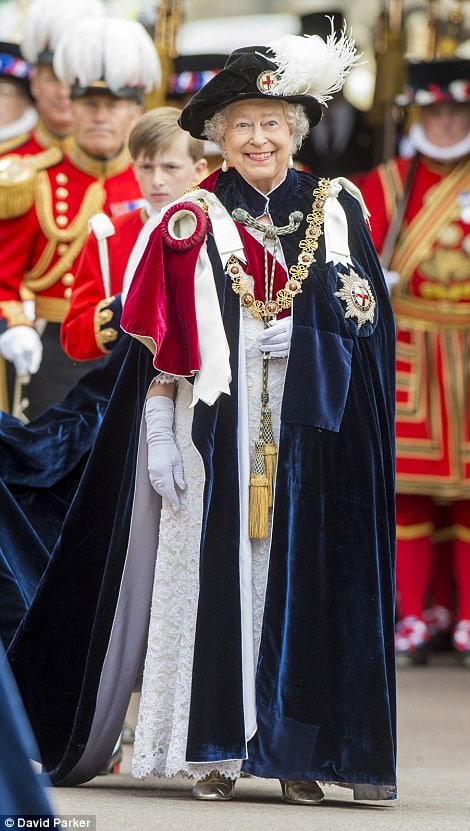
Knights of St. George and the Garter
In Britain King Arthur, emulating the Israelite martyr, (some even say George was of the lineage of St Joseph of Arimathea who founded the British Church), instituted the British Age of Chivalry when he founded the Order of St. George and the Round Table at Windsor.
And when Christendom united to wage holy war upon the infidel occupying the saint’s homeland, it was the blood-red cross of St. George that they emblazoned upon their armour.
At least one legend has it that the exhausted Crusaders took fresh heart from a vision of St. George, resplendent in dazzling armour and mounted upon a fine charger, over the Mount of Olives, sword held aloft, as they stormed the ramparts of the Holy City.
But it was in Britain that the cult really took root when Edward III revived the Arthurian Order of St. George, making Windsor again the centre of European chivalry, proclaiming the soldier-saint National Patron.
Ever since then, beneath five-and-twenty knightly knees of members of the country’s highest Order of Knighthood, the coveted band of the Knights of St. George and the Garter, has rested – symbol of Christian unity and courage. The Garter finds its beginning in the ’round table’ spirit of Arthurian days and not, as one vulgar story has it, in the amused titterings of the courtiers of Edward III when, to her embarrassment, the Countess of Salisbury dropped her garter on a dance-room floor.
And throughout the far-flung quarters of the globe , wherever Britain ‘s sons have broken forth , on the right hand or the left, inheriting the desolate heritages of the earth, they have borne the Georgian banner, under which colonists and missionaries, engineers and doctors, statesmen and magistrates, have preached and practised the Faith of Christ, forwarding in impressive measure Christ’s cause; in defence of which St. George of Lydda, eighteen centuries ago, laid down his life.
D.J.C
