
THE CAPTIVITIES
The Plain Facts about Israel and Judah
AFTER the death of Solomon, the Israel nation was divided into two kingdoms: in the south the tribes of Judah and Benjamin, usually called ‘the house of Judah’, were ruled over by the Davidic line of kings in Jerusalem; while in the north a series of non-Davidic dynasties ruled over the remaining ten tribes, usually known as ‘the house of Israel’, subsequently with Samaria as their capital.
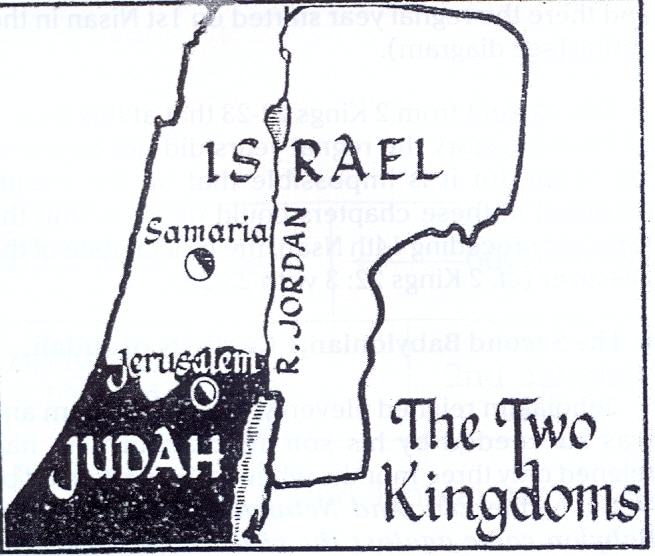
Both kingdoms lapsed into idolatry, for which they went into exile in fulfilment of prophecies uttered by Moses before they ever entered the land. Seven stages in their deportation are recorded. The northern kingdom was completely removed by the Assyrians in three stages, the Assyrians also taking captive a first instalment of Judah. The remainder of the House of Judah was taken captive to Babylon in three stages, though a final remnant did escape to Egypt.
A THE ASSYRIAN CAPTIVITIES
 I.The First Captivity of Israel
When the Israelites were invaded by the Assyrians under Tiglath Pileser, it was the Trans-Jordan tribes which were the first to be taken captive. We read in 1 Chronicles 5:26 that ‘the God of Israel stirred up the spirit of Pul king of Assyria, and the spirit of Tilgath Pilneser king of Assyria, and he carried them away, even the Reubenites, and the Gadites, and the half tribe of Manasseh, and brought them unto Halah, and Habor, and Hara, and to the river Gozan, unto this day’.
It will be recalled that these were the tribes who had asked for, and were promised by Moses, an inheritance east of Jordan.
2.The Second Captivity of Israel
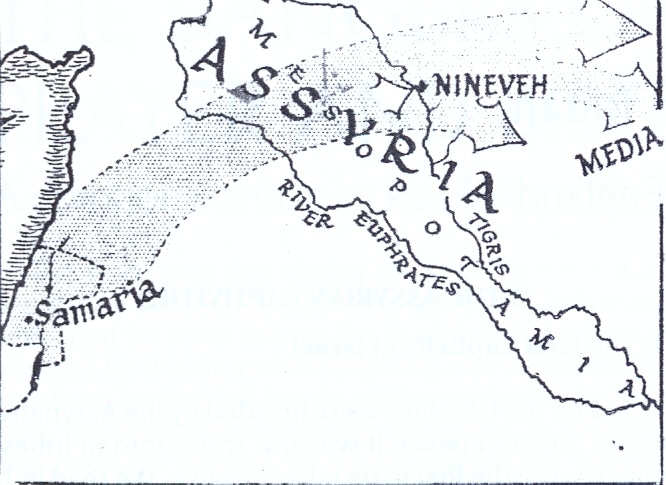 Later, Samaria itself was besieged by. the Assyrians under Shalmaneser and Sargon, and the main body of the House of Israel was taken captive and deported to the same places as their Trans-Jordan compatriots. Thus we are told in 2 Kings 17: 5-6 that ‘the king of Assyria came up throughout all the land, and went up to Samaria, and besieged it three years. In the ninth year of Hoshea the king of Assyria took Samaria, and carried Israel away into Assyria, and placed them in Halah and in Habor by the river of Gozan, and in the cities of the Medes’.
Media was that north western part of Persia which lies between Assyria(northern Mesopotamia) and the Caspian Sea.
3.The Final Deportation of Israel
It appears that the last remnants of the House of Israel were removed by the Assyrian king Esar-haddon who replaced them by captives which he had taken in Babylonia (southern Mesopotamia). This is recorded in 2 Kings 17:24: ‘And the king of Assyria brought men from Babylon, and from Cuthah, and from Ava, and from Hamath, and from Sepharvaim, and placed them in the cities of Samaria instead of the children of Israel: and they possessed Samaria, and dwelt in the cities. thereof.’
It is recorded in Ezra 4: 2 and 4: 9 that these foreign tribes were imported by the Assyrian king Esar-haddon; they were the ancestors of the people who later became known as Samaritans in our Lord’s time.
4.The Assyrian Captivity of Judah
The Assyrians were also responsible for deporting a part of the southern kingdom of the House of Judah. Thus we read that ‘in the fourteenth year of king Hezekiah did Sennacherib king of Assyria come up against all the fenced cities of Judah, and took them’ (2 Kings 18: 13).
The Assyrian records say that Sennacherib took 46 strong cities and innumerable villages, carrying away 200,150 captives, but there is nothing to say where they went-it is possible that they joined the Israelites already in captivity in Media.
In answer to Hezekiah’s prayer, the Assyrian armies besieging Jerusalem were destroyed overnight by divine intervention, and the remnant of the House of Judah continued to exist in the land for another hundred years. Eventually Josiah, king of Judah, was killed in battle against the Egyptians; his son, Jehoahaz, was taken captive, and the Jews became subject to Egypt.. ‘And Pharaoh-nechoh made Eliakim the son of Josiah king in the room of Josiah his father, and turned his name to Jehoiakim’ (2 Kings 23: 34)
Meanwhile, Babylon was replacing Assyria as dominant power in the east, and in the year 605 B.C. Nebuchadnezzar defeated the Egyptian army sent to support Assyria at the battle of Carchemish. This is referred, to in Jeremiah 46:1-2 as happening in the fourth year of Jehoiakim: ‘The word of the Lord which came to Jeremiah the prophet against the Gentiles; against Egypt, against the army of Pharaoh-Necho king of Egypt, which was by the river Euphrates in Carchemish, which Nebuchadrezzar king of Babylon smote in the fourth year of Jehoiakim the son of Josiah king of Judah.. ..’
B. THE BABYLONIAN CAPTIVITIES
5.The First Babylonian Captivity of Judah
Immediately following his victory at Carchemish, Nebuchadnezzar advanced on Egypt and besieged Jerusalem, whence he took captive some ofthe better class Jews, among whom was Daniel: ‘In the third year of the reign of Jehoiakim king of Judah came Nebuchadnezzar king of Babylon unto Jerusalem, and besieged it. And the Lord gave Jehoiakim king of Judah into his hand, with part of the vessels of the house of God: which he carried into the land of Shinar to the house of his god; and he brought the vessels into the treasure house of his god. And the king spake unto Ashpenaz the master of eunuchs, that he should bring certain of the children of Israel, and of the king’s seed, and of the princes among these were of the children of Judah, Daniel, Hananiah, Mishael and Azariah’ (Dan. 1:1-6).
The apparent disorepancy between the dates given by Jeremiah and Daniel arises from the fact that Jeremiah was writing in Jerusalem where the regnal year of the king began on Ist Tisri in the autumn, whereas Daniel was living in Babylon when he wrote, and there the regnal year started on Ist Nisan in the spring (see diagram).
It is evident from 2 Kings 22-23 that at this period of Jewish history the regnal years did not begin on Ist Nisan, for it is impossible that all the events recorded in these chapters could occur within the fortnight preceding 14th Nisan, the official date of the Passover (cf. 2 Kings 22: 3 with 23:23).
6.The Second Babylonian Captivity of Judah
Jehoiakim reigned eleven yeas in Jerusalem and was succeeded by his son Jehoiachin who had reigned only three months when he was attacked by Nebuchadnezzar: ‘And Nebuchadnezzar king of Babylon came against the city, and his servants did besiege it. … . And be carried away all Jerusalem, and all the 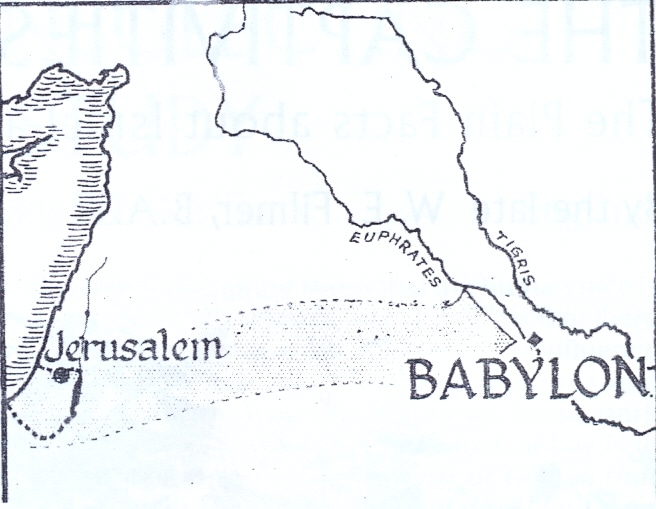 princes, and all the mighty men of valour, even ten thousand captives, and all the craftsmen and smiths: none remained, save the poorest sort of the people of the land. And he carried away Jehoiachin to Babylon, and the king’s mother, and the king’s wives, and his officers, and the mighty of the land, those carried he into captivity from Jerusalem to Babylon’ (2 Kings 24:11-16).
It is stated in verse 12 that this occurred in the eighth year, i.e. the 8th year of Nebuchadnezzar which was 597 B.C. Ezekiel was taken into exile at this time, for he dates all his prophecies from the time of Jehoiachin’s captivity (see Ezek. 1: 2, etc.).
7. The Final Deportation of Judah
The Babylonians made Jehoiachin’s uncle king, and changed his name to Zedekiah: ‘And it came to pass in the ninth year of his reign, in the tenth month, in the tenth day of the month, that Nebuchadnezzar king of Babylon came, he, and all his host, against Jerusalem, and pitched against it; and they built forts against it round about. And the city was besieged unto the eleventh year of king Zedekiah’ (2 Kings 25: 1-2).
Thus Jerusalem fell in 586 BC, and the temple, the king’s palace and the whole city were destroyed by fire. ‘And they slew the sons of Zedekiah before.his eyes, and put out the eyes of Zedekiah, and bound him with fetters of brass, and carried him to Babylon’ (2 Kings 25:7).
The Remnant Escape to Egypt.
‘As for the people that remained in the land of Judah, whom Nebuchadnezzar king of Babylon had left, even over them he made Gedaliah … ruler’. (v. 22). Gedaliah was, however, soon assassinated, ‘and all the people, both small and great, and the captains of the armies, arose, and came to Egypt: for they were afraid of the Chaldees‘ (v. 26).
According to the prophecy of Jeremiah 44, most of this remnant perished (v. 14) only a few ever returning to their own land (v. 28).
The Kings of Assyria
B.C. REIGN
772-754 18 Assur-dan III
754-745 9 Ashur-nirari V
745-727 18 Tiglath Pileser
726-722 5 Shalmaneser V
722-705 17 Sargon
705-681 24 Sennacherib
680-669 13 Esar-haddon
668-638 30 Assur-bani-pal
The Kings of Babylon
B.C. REIGN
668-648 20 Shamash-shum-ukin
647-626 22 Kandalanu
626-605 21 Nabopolassar
605-562 43 Nebuchadnezzar
562-560 2 Evil-Merodach
560-556 4 Neriglissar
556 – Labashi-Marduk
555-539 17 Nabonidus
NOTE:The ‘first year’ of the king began on 1st Nisan following the king’s accession, the preceding fraction of a year being called ‘the year he began to reign’
